Slatted slabs: glass fibre vs steel

A 2023 study compares precast concrete grids with steel and glass-fibre reinforcement. FRP absorbed up to 68% more energy in the bending tests. At equal diameter, steel kept the higher load-bearing capacity.
Can glass-fibre reinforcement be an interesting alternative to traditional steel reinforcement in precast concrete? A scientific study from 2023, available through the University of Warwick, compares the performance of precast concrete grids with steel reinforcement and glass-fibre reinforced polymer reinforcement (FRP).
Fibr analysed the research results in a technical study note, with particular attention to energy absorption, load-bearing capacity, durability and cracking.
The researchers tested 15 precast concrete grids of 1,050 × 600 × 50 mm under four-point bending. Three different concrete mixes were investigated.
The results show interesting differences between the two reinforcement materials.
1. Energy absorption: up to 68% higher with FRP
One of the most striking results concerns the amount of mechanical energy the precast grids could absorb during the bending tests.
For normal concrete, the following values were measured:
| Reinforcement | Steel | FRP | Difference |
|---|---|---|---|
| Ø6 mm | 409 J | 686 J | +68% |
| Ø9 mm | 678 J | 831 J | +23% |
Energy absorption (J)
Ø6 mm
Ø9 mm
Deflection (mm)
Ø6 mm
Ø9 mm
During the tests, the FRP-reinforced elements absorbed considerably more energy than the comparable steel-reinforced elements.
Deformation capacity differed as well. At peak load, FRP Ø6 reached a deflection of 38.5 mm, compared with 26.1 mm for steel Ø6. For Ø9, the values were 45.8 mm and 30.9 mm respectively.
In both cases, that is about 48% more deflection at peak load.
These results show that FRP-reinforced precast grids can have a different deformation and failure response.
For precast producers this is relevant, because their elements are exposed to different loads during production, handling, transport and installation.
2. Load-bearing capacity: steel is higher at equal diameter
Alongside energy absorption, the researchers investigated the maximum load-bearing capacity of the precast grids.
For normal concrete, the following results were measured:
| Reinforcement | Steel | FRP |
|---|---|---|
| Ø6 mm | 28.6 kN | 23.1 kN |
| Ø9 mm | 35.5 kN | 30.1 kN |
Peak load (kN)
Ø6 mm
Ø9 mm
At equal diameter, the steel-reinforced elements reached a higher peak load: about 19% higher for Ø6 and 15% higher for Ø9.
An important explanation lies in the different mechanical properties of the two materials. The steel reinforcement had a modulus of elasticity of about 210 GPa, compared with 45.6 GPa for the FRP reinforcement in the study.
This does not mean that FRP cannot be a suitable solution for the same precast application.
The final load-bearing capacity is not determined by the material alone, but also by the amount, diameter, position and configuration of the reinforcement.
Scope for optimisation
By increasing the reinforcement section, adjusting the bar layout or using materials with a higher modulus of elasticity, it can be investigated how an FRP-reinforced element can meet the required load-bearing capacity and stiffness.
These possibilities have to be validated in each case with calculations and product-specific tests.
3. Durability: corrosion resistance as an important advantage
The maximum load-bearing capacity of a new precast product is only one part of its performance.
Durability over the full service life also plays an important role.
Traditional steel reinforcement can corrode when exposed to moisture and aggressive substances. The rust can then reduce the effective steel section and damage the surrounding concrete.
Glass-fibre reinforcement does not undergo steel corrosion.
This makes FRP particularly relevant to investigate for precast products exposed to moist or chemically aggressive environments, including certain agricultural applications.
What does additional ageing research show?
A separate scientific study by Park, Kim and Lee (2014) investigated the flexural capacity of steel- and FRP-reinforced concrete beams after accelerated ageing.
After 300 days under the accelerated ageing conditions in that study, the following losses of flexural capacity were reported:
| Reinforcement | Loss of flexural capacity |
|---|---|
| Steel | 10.3%–21.7% |
| FRP | 0.5%–4.6% |
In this test, the FRP-reinforced beams that were studied retained a larger share of their original flexural capacity.
This underlines the importance of durability when choosing a material.
The results come from a different study, with different specimens and exposure conditions. They cannot be applied directly to the precast grids in the Warwick study, or used as a service-life prediction for Fibr products.
For FRP as well, the quality of the fibres, resin, bond and resistance to long-term exposure remain important points of attention.
4. Cracking: smaller measured crack widths with FRP
Crack control is an important part of precast concrete design, both technically and from a durability point of view.
The researchers therefore compared cracking in the steel- and FRP-reinforced elements.
At the service load investigated in the study, the following values were measured in normal concrete:
| Reinforcement | Steel | FRP |
|---|---|---|
| Ø6 mm | 0.38 mm | 0.35 mm |
| Ø9 mm | 0.25 mm | 0.20 mm |
Crack width (mm)
Ø6 mm
Ø9 mm
At equal diameter, the FRP-reinforced elements showed roughly 8% to 20% smaller crack widths.
That is an interesting result, because controlling cracking can play an important role in the functionality and durability of precast products.
The researchers did observe differences in how the cracks were distributed. With FRP, damage was more locally concentrated, while steel showed a more distributed crack pattern.
Steel
FRP
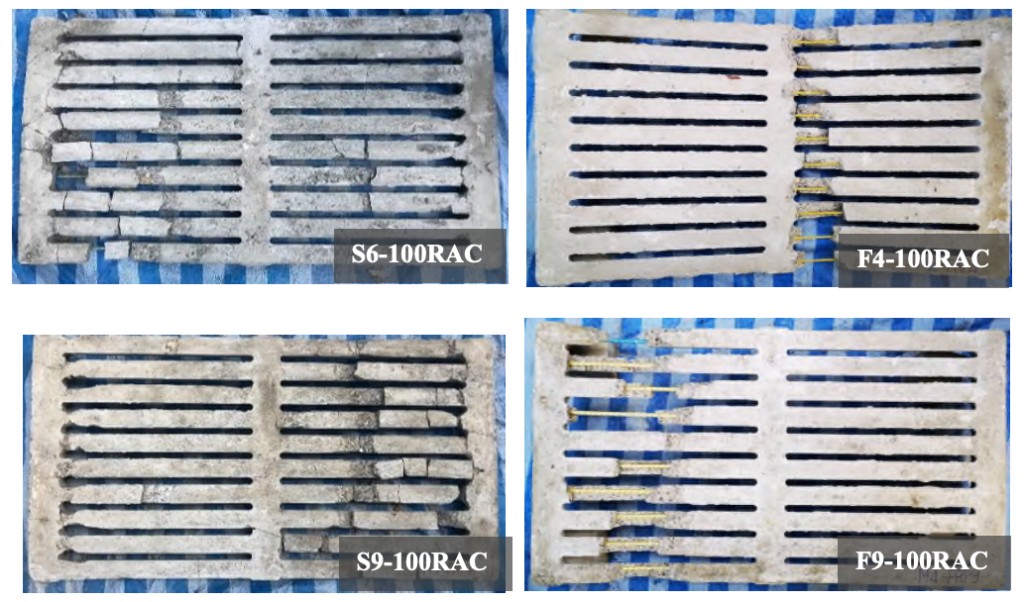
These results therefore always have to be assessed together with the load-bearing capacity, bond and deformation of the complete concrete element.
5. What does this mean for precast producers?
The study makes clear that FRP does not necessarily have to be treated as an identical replacement for traditional steel reinforcement.
The specific properties of glass-fibre reinforcement offer opportunities to tune the reinforcement design to the technical requirements of individual precast products.
Depending on the application, several parameters can be optimised:
- Load-bearing capacity: adjust the amount, diameter or position of the reinforcement.
- Stiffness: investigate alternative reinforcement layouts and materials with a higher modulus of elasticity.
- Crack control: optimise bar distribution, bond and anchorage.
- Durability: evaluate corrosion resistance and exposure to aggressive environments.
- Product design: investigate whether adapted reinforcement makes new element geometries or more efficient production possible.
The possible benefits have to be investigated and validated separately for each precast product.
Conclusion
The scientific study shows that FRP reinforcement can offer interesting properties for precast concrete.
At equal diameter, the steel-reinforced elements reached a higher peak load. The FRP-reinforced elements, by contrast, showed higher energy absorption during the bending tests, smaller measured crack widths and greater deformation at peak load.
Together with corrosion resistance, this makes glass-fibre reinforcement an interesting alternative to investigate further.
The main conclusion is not that one material performs better in every situation, but that the properties of FRP offer scope for a reinforcement design adapted to the purpose.
Investigate the possibilities for your precast product
Fibr develops glass-fibre reinforcement and investigates how reinforcement configurations can be matched to specific precast applications.
Want to check whether glass-fibre reinforcement is suitable for your concrete product? Send us your existing reinforcement drawing and technical requirements for a first assessment.
The results come from published scientific studies and are not an experimental product validation of Fibr reinforcement.
References
- Imjai et al. (2023). Serviceability behaviour of FRP-reinforced slatted slabs made of high-content recycled aggregate concrete — Structures, 51, 1071–1082. Comparison of steel- and FRP-reinforced precast grids; this article uses the normal-concrete results.
- Park, Kim & Lee (2014). Long-Term Flexural Behaviors of GFRP Reinforced Concrete Beams Exposed to Accelerated Aging Exposure Conditions — Separate ageing study on concrete beams. Not directly applicable to the precast grids, and not a service-life prediction for Fibr products.
- Fibr. University of Warwick study — Technical analysis of the research results.