


In-house production
Rebar, nets, rolls, fibers and chairs — all manufactured in Oudenaarde, from DIY kits to large pours.
2×
Twice the tensile strength of steel
4×
Four times lighter than steel
>50%
Less CO₂ than steel.
4000 m²
Coverage per truckload

Tomakefiberglassmeshthenewcost-effective,lightweightandnon-corrosivealternativetosteel.
A direct, transparent workflow with engineering and production under one roof.
Our material system is developed for long-term performance in concrete. Fibers, resin and protection are selected to withstand highly alkaline environments and demanding service conditions.
Fiber content, resin system, diameter and geometry are engineered together to achieve the required mechanical performance with efficient material use.
Surface profile, winding and coating are developed to improve the interaction between the FRP reinforcement and concrete, supporting reliable load transfer and pull-out performance.
We engineer more than individual bars. Mesh geometry, spacing, connection points and reinforcement layout are optimized as one system around the structural requirements of each application.
Six reasons contractors switch from steel to Fibr — produced in-house in Belgium.
Rebar, nets, rolls, fibers and chairs — all manufactured in Oudenaarde, from DIY kits to large pours.
Fibr outperforms steel on tensile strength, so you can specify less weight for the same structural demand.
Crews handle it by hand. Trucks carry more coverage per load, which cuts transport cost and time on site.
Non-corrosive in wet rooms, pools, marine and chemical environments — typically more than 75 years of service.
More than 50% less CO₂ in production and transport than steel, with project-level figures for ESG reporting.
Fibr does not hold ATG yet. Certification is expected in 2027.
Built around your project.
Fibr develops and produces its FRP reinforcement in Belgium, giving us direct control over materials, quality, production and continuous product improvement.
Our reinforcement solutions are developed with Eurocode 2 requirements in mind, helping engineers integrate FRP reinforcement into real structural applications with confidence.
Our reinforcement has already been used across numerous construction projects. That field experience feeds directly back into how we design, produce and improve our products.
From production to transport, we quantify the CO₂ impact of our reinforcement and provide project-specific insights into the potential savings compared with traditional steel reinforcement.
Explore recent projects and practical insights into lightweight, corrosion-free reinforcement for concrete and infrastructure.
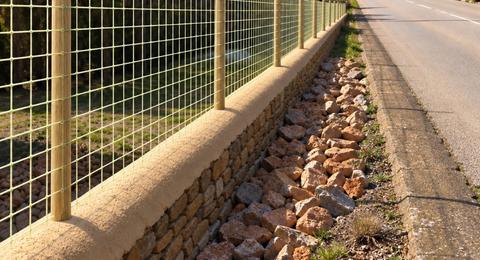
1,800 metres of lightweight, strong and corrosion-resistant glass-fibre fencing as a durable alternative to metal.
Read article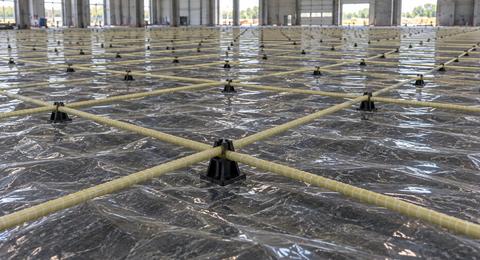
Glass-fibre reinforcement for a 2,100 m² industrial concrete floor: lightweight, fast to install, strong and corrosion-free.
Read article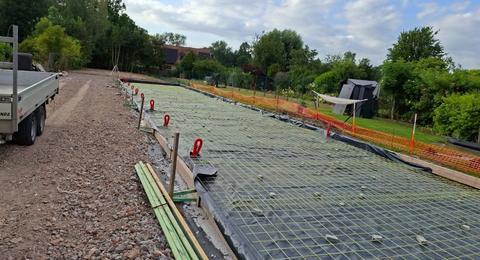
FRP mesh from Fibr Factory replaced steel on a garage box project — lighter to handle and fully corrosion-resistant.
Read articleExperiences from people who specify, install and work with Fibr reinforcement.
After using Fibr glass-fibre mesh, I would not go back to steel. Installation is much faster, and the low weight means far less strain on our backs.
It leaves no rust stains and gives a clean, attractive finish. It is a beautiful product that keeps the concrete looking exactly as intended.
We use Fibr for fencing and are very pleased with it. Its low weight makes installation much easier, and because it is corrosion-free, we do not have to worry about rust.
The essentials on Fibr reinforcement and how it can help your project.
Rebar, nets, rolls, chopped fibers or chairs — produced in-house. Send us a drawing, a question, or an order.
News on FRP specs, lead times and Fibr on the job site.
One email a month at most. Unsubscribe at any time.
Reinforcement: Fibr ///
[ Installation: done ]
[ Ready to pour ]